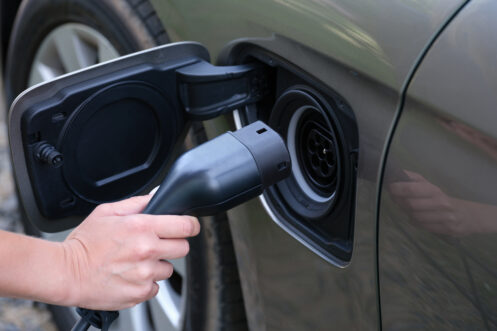
Adding an EV charger to your Lincoln or Omaha, NE home is a great way to increase your property’s value. Level 2 home EV chargers help drivers save time and money. With your own charging equipment, you’ll have full control over your charging costs and your battery’s health. You can also avoid long waits at public charging stations. But part of ensuring the safety and success of these installations is meeting all local permit requirements. In most cases, Level 2 charger installation requires a permit. Read on to find out why and learn how to get one.
When and Why You Need a Permit for EV Charger Installation
All new electric vehicles (EVs) come with branded charging cords. These Level 1 chargers offer easy plug-and-play functionality. You simply connect yours to your vehicle and plug it into a standard 120-volt outlet. Given that they don’t draw much power, Level 1 chargers rarely require electrical system modifications. If you have a relatively new electrical panel, you can use your Level 1 charging cord without tripping the outlet’s circuit breaker or causing other issues.
The primary drawback of Level 1 charging cords is their ultra-slow charging speeds. To restore full battery power, a Level 1 charger can take 54 hours or longer. This is hardly a feasible charging solution for daily commuters. It’s also why people visit public charging stations to use Level 2 or Level 3 chargers instead.
Level 2 Home Chargers Require Electrical System Modifications
Level 2 chargers can restore full battery power in under 12 hours. In fact, some Level 2 chargers can restore full battery power in as few as four hours. However, these chargers draw far more power to do so.
To support a Level 2 charger in your home, you’ll need a special 240-volt outlet and a dedicated circuit. Putting your Level 2 charger on a shared circuit can damage your charging equipment, your outlet, and your battery. It can also lead to frequent circuit breaker trips, electrical shock hazards, overheating, and fast-spreading electrical fires.
As an alternative to outlet-based installation, some homeowners choose to hardwire their Level 2 chargers directly into their electrical systems. With both installation types, it’s necessary to make electrical system modifications. Whenever you modify your home’s electrical system, you must pull the appropriate permits.
Electrical System Upgrades
Given its high power demand, a Level 2 home charger qualifies as a major home appliance. For homes with older, outdated electrical systems, the only way to safely add new major home appliances is by updating electrical panels. You might need a new panel, a panel revision, or a sub-panel. Making any changes to your home’s electrical panel requires a permit.
When Level 2 Chargers Don’t Require Permits
In rare instances, Level 2 charger installation won’t require a permit. For instance, if you already have a 240-volt outlet in your garage that has a dedicated circuit, you may be able to plug your charging equipment in and use it right away. Without hardwiring or electrical system modifications, these straightforward installations sidestep permitting requirements entirely.
However, a Level 2 charger setup rarely offers the plug-and-play ease of Level 1 charging cords. To preserve your charger manufacturer’s warranty, avoid overheating, and prevent electrical fires, it’s best to hire a licensed electrician. Electricians always assess homes’ current electrical demand and check for dedicated circuits. An electrician can ensure that you have the right outlet type and adequate clearance for your charging equipment. Electricians can also assist with smart home integration, installing adequate surge protection, and other important setup tasks.
The Consequences of Not Getting a Permit When You Need One
Permitting for EV charger installation and all other electrical system changes ensures safety. During the permitting process, local planning departments verify that homeowners have completed these projects in accordance with local building codes and the National Electrical Code (NEC).
Failing to comply with permitting requirements during home EV charger installation can result in both immediate and future consequences, including:
- Mandatory removal of charging equipment
- Liability for all resulting property damage
- Mandatory correction of all installation-related infractions
- Loss of home insurance
Problems Selling and Refinancing
Unpermitted electrical installations can lead to problems with selling or refinancing your home. Any real estate transaction that entails a lender-required inspection will call your charger’s permitting into question. If you don’t have a permit for your EV charger, your home will fail these inspections outright. Failed inspections can bring these transactions to a grinding halt.
Loss of Warranty and Insurance Protections
Unpermitted electrical work affects a homeowner’s risk profile. If you have an unpermitted EV charger, you have a higher risk of electrical fires and other potential claim events. Home insurance companies can cancel policies for these and other serious code violations. In some cases, charger manufacturers can cancel equipment warranties, too.
Even if your home insurance company doesn’t cancel your policy, you’ll be financially liable for any property damage your EV charger causes. This includes any damage sustained on neighboring properties.
Fines and Other Penalties
In instances in which faulty EV charger installation results in property damage, homeowners who skip the permitting process may be subject to fines or other monetary penalties. These can range from hundreds to thousands of dollars.
Permitting Requirements in Lincoln and Omaha
Permitting for home EV charger installation is different in each Nebraska city. In Omaha, you must apply for your permit via the City of Omaha Planning Department. In Lincoln, homeowners must submit their permit applications via the City of Lincoln’s Citizen Access portal.
What to Know About Applying for a Permit in Lincoln
For many minor electrical installations, homeowners can apply for permits on their own. These include any installations affecting branch circuits only. For major installations, including EV charger installation, the licensed electricians completing these projects must apply for permits instead.
What to Know About Applying for a Permit in Omaha
Homeowners in Omaha must submit their permit applications in person. This remains true even for major electrical installations that require the services of licensed electricians. To start this process, homeowners can contact the Chief Electrical Inspector to set up an appointment.
How John Henry's Plumbing, Heating, Air, and Electrical Can Help
For more than 28 years, John Henry's Plumbing, Heating, Air, and Electrical has proudly served Lincoln, Omaha, and the surrounding communities. We offer and install high-quality home EV charging stations. We also assist with permitting for EV charger installation. With nearly three decades of local experience, we understand the nuances of local planning departments and each city’s permitting process. We can make sure that all aspects of your EV charger installation are up to code. We’ll also ensure that your electrical panel is compliant as well.
John Henry's Plumbing, Heating, Air, and Electrical is a proud recipient of the Better Business Bureau (BBB) Integrity Award. We also received the BBB Ambassador of Integrity Award and the BBB Excellence in Customer Service Award. To start planning your home EV charger installation in Lincoln or Omaha, get in touch with the electrical experts at John Henry's Plumbing, Heating, Air, and Electrical today.