
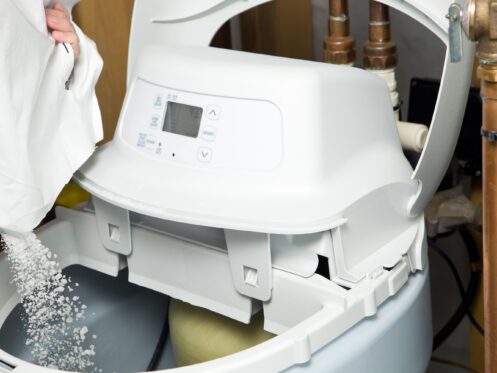
The term “hard water” refers to water that contains a relatively high concentration of dissolved minerals — specifically calcium and magnesium — which can cause mineral deposits in your plumbing. Over time, these mineral deposits can clog up a home’s pipes and reduce the lifespan of some appliances.
According to the US Geological Survey’s Water Hardness Scale, both Omaha and Lincoln have hard water. While we are fortunate not to have extremely hard water like some other parts of the country, installing a water softener in your house, if it doesn’t already have one, is still a wise decision. We’ll discuss the issues that hard water can cause and the benefits a water softener provides.
We’ll also examine the two different types of water softeners and how they work, to help you decide which one is best for your home.
Common Issues Caused by Hard Water
The minerals in hard water tend to dry out your hair when you shower and can lead to your skin feeling itchy. It’s also more difficult to get fully clean when you have hard water, as the minerals prevent soaps and shampoos from lathering as well. This same issue extends to laundry detergent and dishwashing soap as well. The minerals that get left behind when you do laundry with hard water can also cause your clothes to wear out faster and leave them looking a bit dingy and feeling stiff. Washing crystalware in hard water is also a concern, as the minerals can lead to pitting.
The much bigger concern is the impact that hard water has on your plumbing and appliances, such as your washing machine, dishwasher, coffee maker, and ice maker. The mineral deposits that hard water leaves behind continually accumulate and can eventually choke off pipes to the point that it leads to a significant reduction in water pressure. Once this happens, the only way you can fix the issue is to replace all of the affected pipes fully. Mineral deposits also typically cause internal seals in appliances to wear out faster, leading to the appliance leaking whenever it’s in use.
Hard water also has a significant impact on water heaters. All water contains at least some dissolved minerals, and some of these minerals always end up solidifying into solid sediment when the water is heated. If you have hard water, sediment will build up inside your hot water tank more quickly and eventually lead to the water heater not performing as well if you don’t frequently flush the tank to remove the sediment.
Sediment also creates an increased risk of the tank eventually leaking, as it absorbs heat and creates hot spots that slowly weaken the bottom of the tank. If you have a tankless water heater, hard water leads to an increase in the amount of limescale and mineral deposits that form within its heat exchanger. If you don’t descale the unit often enough, this will eventually lead to the unit not heating all that effectively and not lasting as long as it usually would.
Benefits of Having a Water Softener
The most significant benefit of installing a water softener in your home is that it can help you avoid expensive plumbing repairs and needing to replace your appliances more often. Water softeners typically last between 7 and 15 years. Even if you had to replace your water softener more frequently, the cost of doing so is negligible compared to the expense of repiping your entire house because all your pipes are severely clogged with mineral deposits.
With a water softener, your clothes will also look cleaner and last longer. Another benefit is that you don’t need to deal with the hassle of constantly cleaning mineral deposits off your shower door and dishes and needing to unclog your showerheads and faucets regularly.
Traditional vs. Salt-Free Water Softeners
Traditional water softeners employ an ion-exchange process that removes calcium and magnesium from the water as it flows through the softener tank, replacing these minerals with a small amount of sodium or magnesium salt. How it works is that the tank is first flushed with a brine solution, which results in the sodium or magnesium ions clinging to the thousands of tiny resin beads inside the tank.
These ions are naturally attracted and stick to the resin beads due to their being oppositely charged. The calcium and magnesium ions in hard water also carry the opposite charge to the resin beads but have a stronger charge than the salt ions. The result is that the minerals stick to the resin beads and displace the salt particles.
The amount of salt that a traditional water softener adds to the water is pretty minimal and not enough that you can taste it. Nonetheless, it can still be a concern for people with specific health problems. The bigger issue is that the salt eventually ends up in rivers, lakes and streams, where it can cause environmental damage.
A single water softener will never release enough salt, but the effect can quickly add up when many homes in an area all have water softeners. The other concern is the amount of water traditional water softeners waste each time the tank gets flushed to remove all of the minerals. These issues are why some municipalities and states now have laws banning the use of traditional water softeners.
Brine-free water softeners don’t present any of these problems, as they don’t add salt to the water. The more accurate name for this type of unit is a water conditioner. Water softening involves removing minerals from the water by filtration, which isn’t what these water treatment systems do. Although this type of unit still prevents mineral deposits from forming, the minerals remain in the water after it flows out of the unit.
Many brine-free water softeners contain special resin beads that alter the chemical structure of the dissolved minerals, which causes them to crystallize and clump together. Some units instead use a magnetic field or add a harmless chemical to the water to achieve the same result.
With all units, the result is that the mineral crystals remain suspended in the water, preventing them from getting left behind and forming deposits inside pipes and fixtures. You can still end up with some mineral deposits if you have this type of unit but nowhere even close to the amount that you would otherwise.
If you’re concerned about hard water in your home, John Henry's Plumbing, Heating, Air, and Electrical has the solution you need. We’ve been serving Nebraska homeowners for nearly three decades and are among the most trusted names for professional plumbing services in Lincoln, Omaha and the surrounding areas.
Whether you want to install a traditional or a salt-free softener, you can trust us to expertly manage the installation from start to finish without any hassle or mess. We also offer a range of effective water filtration options and can handle all your other plumbing needs.
For more information or to schedule service, contact us today.